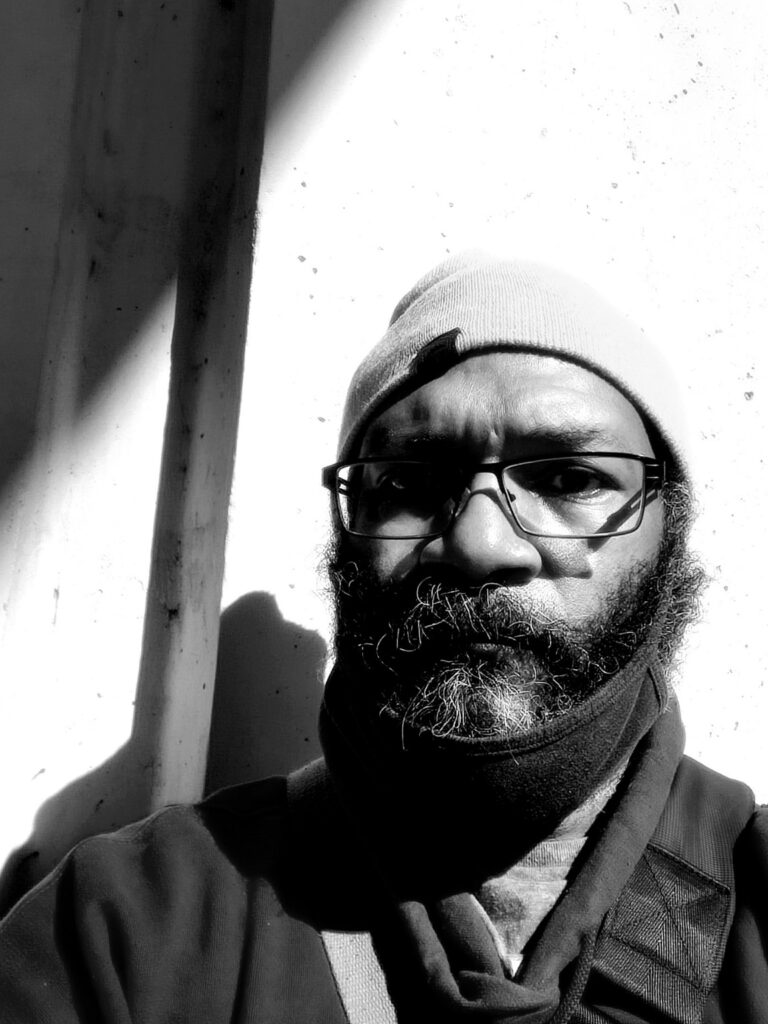
On Whose Shoulders I Stand
No serious artist arrives alone.
Even the ones who appear to come from nowhere come carrying voices, pressures, permissions, refusals, wounds, disciplines, and ghosts. Some of those inheritances are chosen. Some are absorbed before language. Some arrive through museums and books. Some through family rooms, street corners, school hallways, failed institutions, dangerous neighborhoods, and the private weather of people who survived more than they should have been asked to survive.
My work begins there: not in the desire to make beautiful things, though beauty sometimes survives the process, but in the need to make pressure visible.
I do not claim equality with the artists whose work made mine possible. I claim debt, conversation, and pressure. I stand in conversation with artists who treated abstraction not as escape, but as language. I stand with those who understood that a line can carry thought, that color can bruise, that gesture can testify, that rupture can become architecture.
But lineage is not obedience. I am not trying to paint after Kandinsky, Gorky, Krasner, de Kooning, Frankenthaler, Norman Lewis, Jack Whitten, Bearden, Lawrence, Basquiat, or anyone else. I am trying to enter the rooms their work made possible and find out what my own pressure does there.
I was born just outside Chicago, and spent much of my formative life in The Patch in Gary, Indiana, folded into a world where drugs, violence, sex, alcohol, and ordinary survival were present facts, not distant stories. I was raised in large part by my maternal grandmother, a Black Southern woman carried north before she was ready by the pressures and promises of the Great Migration. What she lacked in formal education, she more than made up for in wisdom, compassion, and a steady moral intelligence I still trust more than many official forms of knowledge. My grandfather was there, too, but presence is not the same as nurture. She remained his anchor while he made her life harder than it should have been. I was spared the worst of him physically, but I was not spared the knowledge of what he cost her. They have both been gone for decades, and still I remain angry for her.
That anger is not all of the work. But it is in the work. So are tenderness, discipline, humor, hurt, confusion, disappointment, and the disorientation that comes from being asked to trust rooms that have already misread you. So are overwhelm, mistrust, disenfranchisement, refusal, memory, and the stubborn belief that a surface can tell the truth without explaining itself politely.
My work exists where those pressures meet.
To understand that work, I have to begin with abstraction—not as style, not as decoration, but as language.
Abstraction as Language
Abstraction was never merely an aesthetic preference for me. It was a language I recognized before I knew its grammar.
Long before I understood the movements or the history, I understood that some truths become smaller when forced into literal description. Abstraction offered another possibility. It could hold contradiction without resolving it too soon. It could carry emotion without illustration. It could leave room for the viewer rather than dictating every conclusion.
The artists who have most deeply shaped my thinking did not teach me what to paint. They taught me what painting, drawing, and mark-making could do.
From Kandinsky, I learned that abstraction could carry spiritual and emotional weight. From Arshile Gorky, I learned that vulnerability could remain visible inside form. From Willem de Kooning, I learned that gesture could behave like argument, revision, pressure, and force. From Lee Krasner, I learned that destruction and recomposition could belong to the same act of making. From Helen Frankenthaler, I learned the eloquence of stain, soak, openness, and restraint.
Norman Lewis matters to me because his abstraction carries intellect, rhythm, pressure, and witness without surrendering to the demand that Black experience announce itself only through obvious figuration. Jack Whitten matters because he understood the surface as a site of invention, memory, technology, grief, and discipline. Basquiat matters because he built a language that confronted the system while existing in the faces, homes, galleries, museums, and markets of the powerful.
From Bearden and Lawrence, I learned that history, structure, rhythm, community, and formal innovation never have to compete for space. From all of them, I learned that the work can carry Blackness, discontent, beauty, intelligence, experiment, and refusal without asking permission to be taken seriously.
I owe these artists conversation, not imitation.
The Usual Corridor
My journey has not followed the usual corridor.
As a confused, undiagnosed autistic child, I often struggled to understand why I seemed unable to connect with the larger world, and why the larger world so often seemed unable — or unwilling — to connect with me. When I picked up a 35mm camera at age 12, something changed permanently. I have known I am an artist from that moment forward. Photography gave me a language, a path, and a voice. For the first time, people listened — not because I had become more articulate, but because the work was speaking for me.
Photography remains part of my practice, but it also opened the door to other forms of artistic expression: painting, drawing, writing, sculpture, spoken language, and every medium that lets the work say what ordinary speech cannot.
I am a Black, neurodivergent person who survived systems that often did not reward intellectual curiosity from someone who looked like me. I am a disabled military veteran, so I have lived inside a system built, often quite literally, to beat independent thinkers into compliance. I was raised in a world that demanded I find strength where nurture was often scarce and, sometimes, nonexistent.
Poverty also shaped the route. The usual corridor is easier to recognize and enter when a society has trained you to believe you belong near its doors, and has entitled some to find it early through security, stability, permission, and institutional fluency. Instead of inheriting those entitlements, I was bequeathed something very different. I was taught that wistful thinking, wishful thinking, and art-school dreaming were not for me. Hustle, practicality, survival, bootstraps — but not the boots — that was the “ethic” offered to people like me. They told me plainly: “If it don’t make dollars, it don’t make sense.”
I have discarded that ethic.
I do not make art to justify my usefulness. I do not make art as hustle, side work, decoration, craft, or pastime. I make art because this is the truest form my life has found. The work is not a reward for productivity. It is not proof that survival was worth something. It is a serious, continuing practice rooted in self-fulfillment, inquiry, discipline, and the need to make pressure visible.
These experiences are not detours. They comprise the lens through which my work sees and the language through which it speaks.
Today, I live and work in Texas, where my studio practice continues to evolve in conversation with artists, collectors, and communities throughout the Dallas-Fort Worth area. Every place I have lived remains present in the work, but Dallas is where the current chapter is being written.
So I continue becoming my own teacher.
I do not reject traditional artistic education. I reject the idea that it is the only corridor through which serious art can arrive. A formal route can produce rigorous work, and an unconventional route can produce rigorous work. Either route can also produce nonsense. What matters is not the prestige of the road, but the seriousness, sincerity, discipline, and necessity the artist brings to the work.
I study art history obsessively. I paint and draw and layer and scrape. I fail, research, question, return, and begin again. I learn from museums, libraries, artists, conservators, critics, and from the surfaces themselves. My path is unconventional. I trust you will find that it produces work no less serious.
Working Rage
Working Rage is the name I give to the pressure that remains after politeness has failed, but destruction is not an acceptable answer.
It is not tantrum. It is not grievance for its own sake. It is not the performance of anger. It is what happens when hurt, intelligence, memory, refusal, disappointment, and discipline remain in motion long enough to become form.
I am interested in rage that works.
By that I mean rage that builds instead of merely detonating. Rage that studies. Rage that remembers. Rage that refuses to become either spectacle or silence. Rage that can enter a surface through color, line, stain, scrape, rupture, density, humor, tenderness, and pressure. Rage that can hold contradiction without becoming incoherent.
Working Rage is also my answer to the expectation that certain people must make their pain polite before it can be received. I have spent much of my life watching rooms decide whether a person’s experience was legible enough, credentialed enough, calm enough, respectable enough, or useful enough to be believed. My work refuses that bargain. It does not ask pain to arrive in its best clothes.
That does not mean the work is only angry. It is not. Anger may be one of its engines, but the work also carries grief, absurdity, wit, longing, exhaustion, joy, sensuality, memory, and a strange faith in continued making. Rage alone would be too small. Working Rage interests me because it is rage under discipline, rage in conversation with craft, rage that has learned how to stay alive without becoming obedient.
It is the method by which pressure becomes architecture.
Working Rage moves through my painting and drawing, but also through my writing, poetry, song, spoken language, sculpture, photography, and every other form in which I try to make pressure visible. The medium may change. The inquiry does not.
I claim the honor of having named Working Rage, but I do not wish to possess it. Working Rage is larger than me. It names a pressure many artists have known, carried, resisted, transformed, and survived. I happened to give it language, but I believe the name and the concept belong to Art. I want other artists to adopt it, argue with it, foster it, extend it, and call it by its given name when it helps them understand what their own work is doing. A name can become a room. Those who enter should be prepared to meet its rigor, withstand its pressure, and use it to create. I am eager to see who enters, what they carry, and what their work makes possible.
The question is always: what can this material carry, and what must it refuse?
The Viewer’s Role in Working Rage
The viewer is not incidental to Working Rage. Not a mere spectator, critic, or shopper. The viewer is a critical part of how this work communicates. Without the viewer’s active participation, the work may still speak, shout, rupture, and insist — but the conversation remains unfinished.
I do not ask the viewer to like the work quickly. I do not even ask the viewer to understand it quickly. First response matters, but it is not the whole encounter. A surface may repel before it opens. A color may irritate before it clarifies. A mark may seem chaotic before its discipline becomes visible. Some works give themselves away at once. Mine often do not. They gather.
You should expect these works to surprise you. More than that, expect them to confront you. Often, that confrontation will be uncomfortable. As it should be.
That gathering requires time.
As an artist whose works sometimes enter private homes and offices, I often hear from collectors that a particular piece has become clearer, or spoken more profoundly, after they have lived with it in their space for some time. That is, for me, a wonderful validation of the work I endeavor to create. Who knows how long that metamorphosis may take for any given work or any given collector? I can only say that this deepening is part of the life I fervently believe my work is capable of having.
That deepening can never be passive. It happens because the work continues to press against the space, and because the viewer remains available to what the work is doing.
To remain available is to move past the first reflex: past decoration, past taste, past the easy question of whether a thing is beautiful, past the habit of deciding too quickly what a work is “about.” Working Rage does not always explain itself politely. It does not arrive with a clean thesis pinned to its shirt. It asks for a different kind of attention.
When I encounter viewers who consider themselves skeptical of abstraction, or skeptical of my work in particular, I often suggest they begin by finding one thing in the piece: a line, a mark, a color, a shape, a passage, a tension. Something they like. Something that bothers them. Something they keep returning to. Almost everyone can find one such place to begin.
From there, another may appear. Then another. This does not mean the viewer will love the work by the end of the encounter. Love is not the point. But focusing on the parts can make a way through the whole. It can move a viewer from dismissal toward attention, from overwhelm toward entry, from “there is nothing here for me” toward “there is something here worth my effort.”
I learned this before I understood it. As a young person visiting the Art Institute of Chicago, I devised what I thought was a scheme for appearing to appreciate abstract works I did not yet know how to enter. I would focus on one small thing in the piece and let that stand in for understanding. Over time, I realized I was not pretending. I had stumbled onto a real way in.
The viewer brings their own pressure into the room. Their memory. Their class position. Their race. Their gender. Their wounds. Their formal training or lack of it. Their comfort with abstraction. Their suspicion of abstraction. Their willingness, or unwillingness, to be unsettled. I do not control those things, and I do not want to. The encounter between viewer and work should remain alive enough to resist total management.
But I do ask the viewer to stay honest.
If the work unsettles you, ask where the disturbance begins. If it attracts you, ask what kind of beauty survived the pressure. If it confuses you, consider whether confusion is always failure, or whether it may sometimes be the first honest stage of seeing. If it angers you, ask whether the anger belongs only to the work, or whether the work has touched something you carried into the room.
This is not a demand for agreement. Agreement is too small a goal. I am interested in encounter. I am interested in what happens when a viewer gives the work enough time to stop being an object and begin behaving like a presence.
That is where the conversation begins.
Working Rage does not ask the viewer to solve the work. It asks the viewer to participate in the pressure the work has made visible: to look, return, question, resist, feel, and remain long enough for the surface to answer in more than one voice.
Closing
I do not believe art exists to make people obedient, comfortable, or easily categorized. I believe it exists to make encounter possible. Sometimes that encounter arrives through beauty. Sometimes through disturbance. Sometimes through recognition. Sometimes through pressure.
What matters to me is that the encounter be real.
Everything in this practice — the materials, the surfaces, the ruptures, the abstractions, the density, the gesture, the refusal, the tenderness, the confrontation — is in service of that reality. I endeavor to make works that continue speaking after the viewer looks away. Works that remain active in memory. Works that press against the room long after the room has gone quiet.
That is my work.
That is Working Rage.